


Recent Articles

What We Do
Resilient Grains: From Genomics to Field, From Field to Health.
Food systems face growing pressure from environmental stress, emerging diseases, and the need for healthier diets. At the UC Davis Small Grains Genetics and Breeding Program, we develop wheat, barley, oat, and triticale varieties that thrive under real-world farming conditions––requiring less water, fewer inputs, and stronger tolerance to environmental stress.
Our research integrates genomics, quantitative genetics, and field-based experiments to develop crops that support farmers, protect the environment, and contribute to healthier food systems.

Research in Action
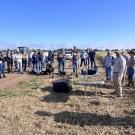
Our work spans field trials, genomic discovery, and international collaboration. Students and researchers evaluate breeding populations of wheat, barley, oat, and triticale in California’s Mediterranean environment, where terminal drought and heat provide reliable stress conditions. Using genomic tools, quantitative genetics, and high-throughput phenotyping, we identify genes controlling disease resistance, stress tolerance, and grain quality. These discoveries feed directly into breeding pipelines to develop improved varieties for farmers. We also focus on developing awnless dual-purpose wheat designed for both forage and grain production while maintaining strong bread-making quality, supporting integrated crop–livestock systems in California.
Join Our Research
We train the next generation of scientists in plant breeding, genomics, and sustainable agriculture. Students and collaborators in our program gain hands-on experience with field experimentation, genetic analysis, and data-driven breeding strategies. Working at the interface of genetics, agronomy, and food systems, they tackle real-world challenges—from improving disease resistance to developing crops that remain productive under drought and low nitrogen conditions.
We offer a range of research topics for undergraduate students who are interested in and comfortable participating in guided research projects within our program.
Nutrition-Focused Wheat Innovation
Bread is one of the most widely consumed foods on Earth. What if it could also help improve human health?
Our program develops elite wheat varieties designed for better nutrition, maintaining yield and quality. These include wheat with higher dietary fibre to support metabolic health, lines with reduced gluten immunogenicity, and new varieties enriched with pro-vitamin A.
By combining genetics, breeding, and food science, we are transforming wheat into a crop that not only feeds the world but also helps keep it healthier.
Lasting Protection
Crop diseases act like ‘hackers’ that are always trying to break into the plant.
Our lab is a key watchdog for the U.S., which means we often see new stripe rust races early. By studying how resistance genes interact and evolve, we design wheat varieties with durable, multi-layered protection rather than short-term fixes.
Instead of relying on a single gene that pathogens can overcome, we build genetic “firewalls” that protect crops for years.
Better Plant Design
Farming should not require ever-increasing fertilizer and water to remain productive.
Our research redesigns crop architecture—the shape and structure of the plant itself. By identifying genes that control plant height, root systems, and nutrient use, we develop varieties that grow shorter, stronger, and more deeply rooted.
These crops can capture water and nutrients more efficiently, helping farmers maintain strong yields with fewer inputs while protecting soil and environmental resources.
Better plant design means better harvests with a lighter environmental footprint.
Digging for Secrets
Modern breeding has pushed crops to deliver record yields—but along the way, some valuable survival traits were left behind.
Our Evolutionary Mining (Evo-Mining) research searches older varieties, landraces, and wild relatives to rediscover these hidden advantages. By studying wheat’s complex genome, we identify genetic mechanisms that help plants tolerate heat, drought, and environmental stress.
These “lost” traits can help create a new generation of crops that remain productive even as climates change.
Sometimes, the future of agriculture lies hidden in the past.